This is what grocery shopping looks like

A locavore’s Saturday morning does not involve sleeping in. Mom and I were up early and on the road by 9 to do go on a scavenger hunt for groceries in the Anderson Valley.The Apple Farm

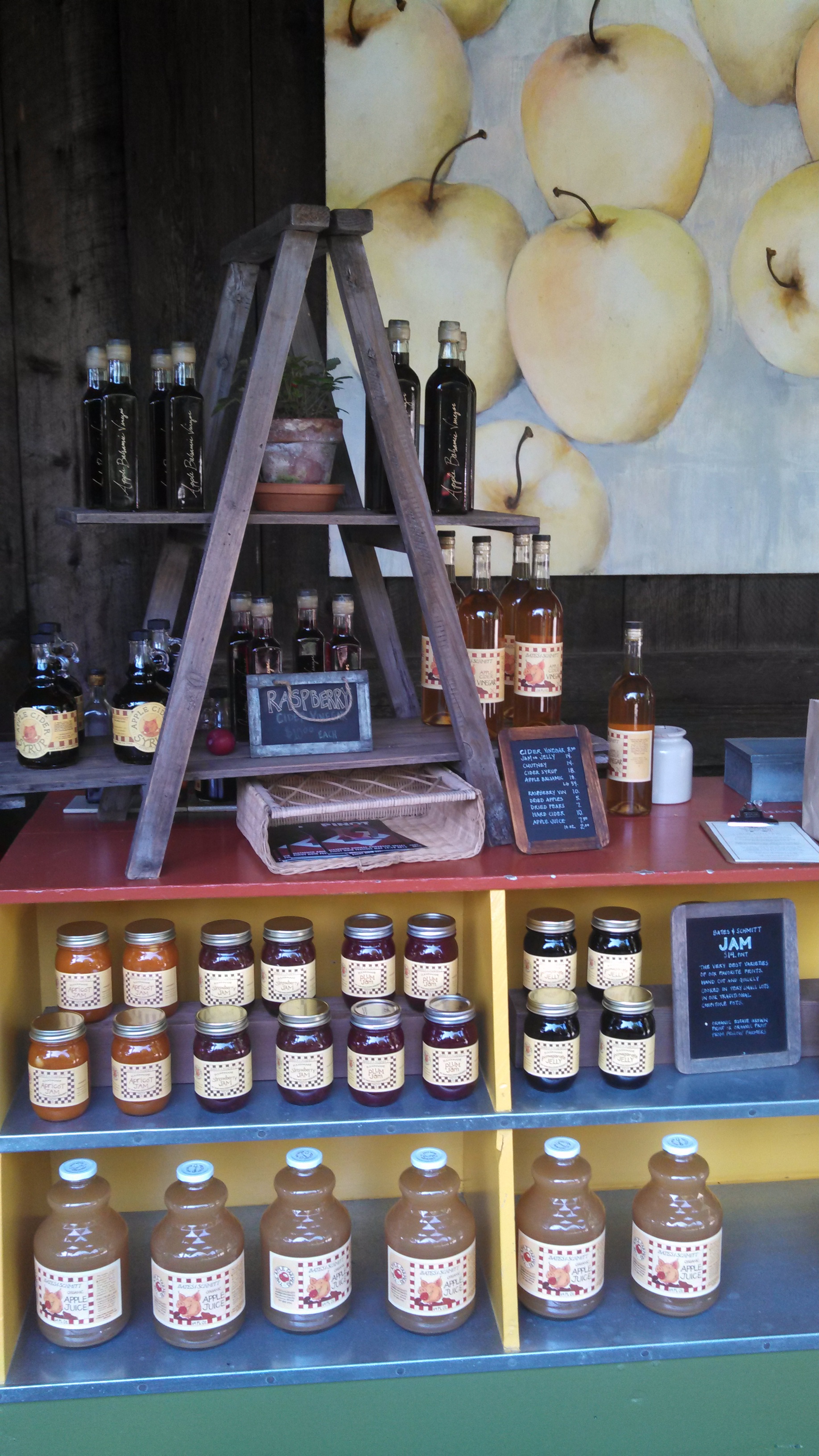
First stop was The Apple Farm in Philo. Pretty sure it’s the cutest farmstand of yummy in the world, with a beautiful pastoral backdrop of barn, apple orchards and the Navarro River nearby. Cuteness aside, Gowan and I had an apple cider vinegar emergency this week, and this is our supplier, so this was a serious visit. When I arrived there was only one bottle on the shelf, so I had to hunt someone down to open another case for us. Phew. Also picked up the first apples of this season!

Next we went to Gowan’s Oak Tree farm and I got a bag of yellow peaches and some walnuts.

Then, to retrieve milk and butter and pop in at the Boonville Farmers’ Market where I discovered some precious duck eggs and a free-range chicken. I also met a farmer who has five laying ducks for sale, so now I just need to convince Gowan to build a pond and a horse stable…

At the Farmhouse Mercantile in Downtown Boonville I discovered this useful vintage diagram. Must study up so I can impress Gowan with my horse knowledge as I fantasize about my future in the saddle.

Vintage drawing of horse anatomy

On the way home we stopped in at Balo Vineyards‘ tasting room and picked up a bottle of Pinot and some Pennyroyal Farms blue cheese. Next time, we’re staying to play bocce ball.

All this and we made it home in time to enjoy a lovely afternoon in Mendocino.

Mendocino headlands

Not exactly your typical stop for groceries, but a lovely way to spend a warm summer morning and a wonderful occasion to put on a sun dress. Instead of rushing through the store aisles in my pajamas, trying not to get stuck in conversations with acquaintances, I look forward to these food forays. You feel differently when you’re going right to the source for your survival; you look forward to the smiles that await you and the brief moment to connect to other human beings who have become part of the ecosystem of your life in this great unending cycle of food and compost.

Candy Cap Mushroom Ice Cream Recipe

I love my mom for many reasons. But, I especially love it when she comes to visit and I wake up to a yummy local breakfast, and a clean stove. Apparently I do did not inherit the gene that motivates you to wipe down the stove after every meal (or the one that makes you fold laundry straight out of the dryer) I decided to demonstrate my daughterly appreciation with some limited edition Mendocino grown candy cap mushroom ice cream.

Disclaimer: Writing recipes is hard because we don’t often use them, or modify them so much at whim that we don’t exactly remember what we did, but we’re just happy it’s not totally gross. We have, however, made this ice cream so many times that we have something that closely remembers a replicable recipe. When I am less than exacting or if things don’t turn out as I hoped, know I am not withholding my secrets – just admitting a highly improvisational approach to cooking. You might finding it liberating to find out that it’s hard to screw up most things.

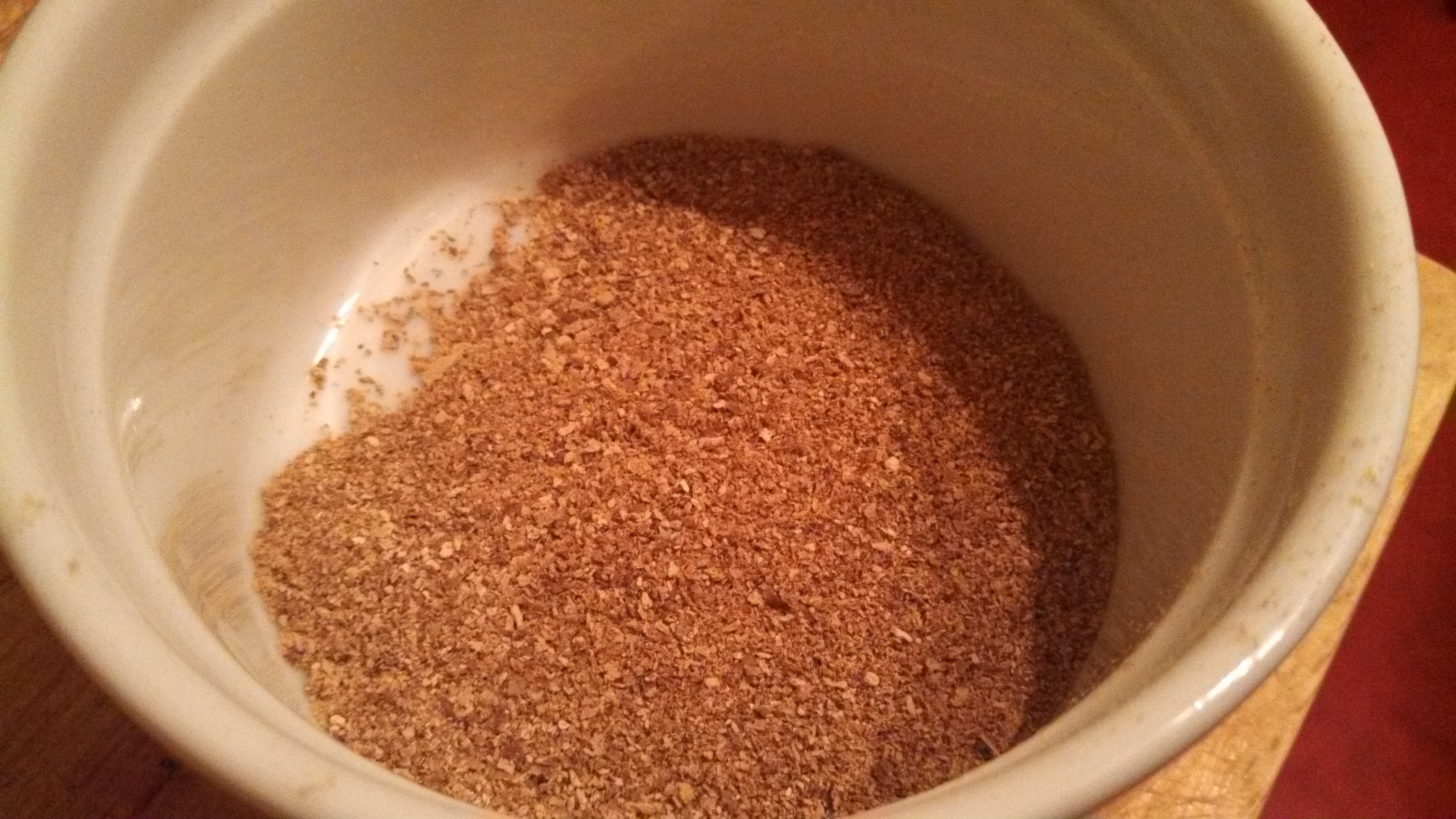
For those of you who are not familiar of the wondrous candy cap mushroom, welcome. They have the scent and flavor of maple syrup and grow abundantly in the woods on the Mendocino Coast. We harvested ours last winter and dried them. Sadly I am down to the bottom of the jar, because we love this ice cream so much. Good thing berry season is here.

Dried candy cap mushrooms

Candy Cap Mushroom Ice Cream

2 cups of milk (we like it whole and fresh). This is the right amount for my ice cream maker – depends on your machine.

about 1/4 c. dried whole candy cap mushrooms (or approximately enough to cover the bottom of the Vitamix blender…)

a few Tbsp. of local raw honey. I used wildflower honey from Lovers Lane Farm

Equipment:

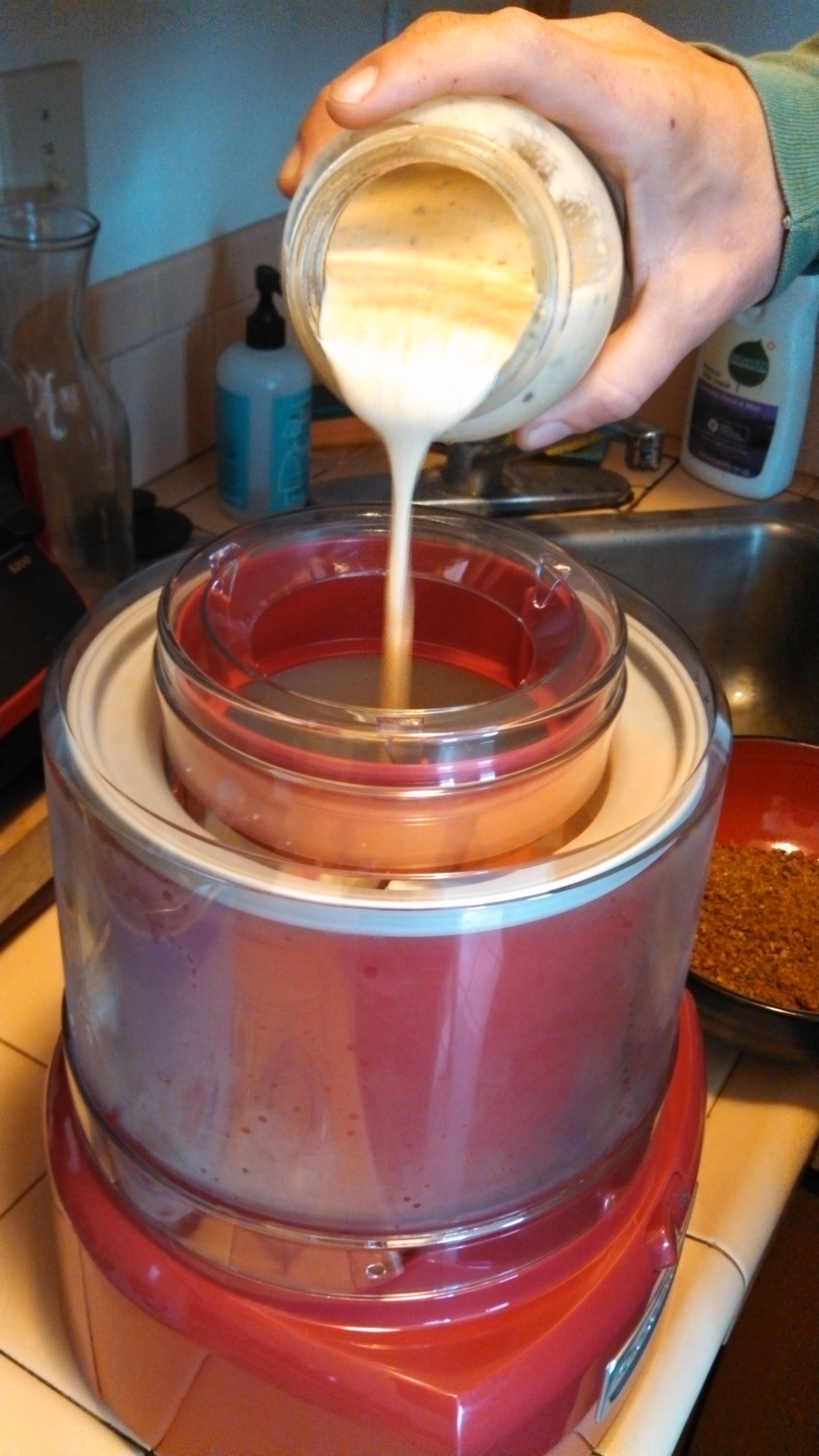
An ice cream maker. This is the Cuisinart that I have and I’ve been really happy with it.

A blender or coffee grinder.

Directions:

Begin by grinding the candy caps in the blender or coffee grinder. I use my Vitamix for this, which powders them really nicely.

Candy cap mushroom powder

Heat two cups of milk in a saucepan until the edges are just starting to simmer. Don’t let the milk burn, as always.

While milk heats, beat 3-4 eggs in a bowl with 2 Tbsp+ of honey. I have started adding a bit more honey. Beat well until blended.

*Slowly* pour the warm milk into the eggs, whisking continuously.

Add candy caps to the mixture and whisk everything together.

Pour the egg/milk mixture back into the saucepan and heat on low, stirring constantly with a big spatula. You may need to lift it off the stove to control the temp – you want it to thicken, but not curdle. This is the only delicate part of the process. Stay alert. *If* it starts to curdle, take it off the heat immediately  and whisk vigorously. It’s probably thick enough once this happens.

Chill the mixture, ideally overnight, in the fridge. In an ice cream emergency, an ice bath will do. The results are much better when the ice cream mixture has cooled completely.

When ready to make ice cream, pour into the ice cream maker. Turn on and let the magic happen. I think it usually takes about 20 minutes.

Cuisinart ICe Cream Maker

Freedom Song for Local Food

In celebration of Independence Day, Gowan, Apple, and Fourth of July ParadeI marched in our quirky little small-town parade today. We wove through the streets of the Mendocino village in a procession of colorful and eclectic floats. It’s a snapshot of our funny little corner of the world which is quite unlike any other place. My mom came to the coast for the holiday to escape the Central Valley heat, so we tasked her with capturing some photos of us. In her characteristic diligent manner, she documented the entire procession. I will upload her pictures to our Facebook page tomorrow, so be sure to follow us.

As we walked with our neighbors, I was reflecting on what we were “standing” for. We were marching with the Moms Across America Label GMO group and flanked by our local and mighty Grange contingent. Our collective message was simple: real, safe food is a right. Our personal statement is that we can choose to exercise this freedom every time we put food in our mouths. Not that it’s simple, not that it’s always cheap, and not that it’s convenient. But, it is our right, and it is one that many of us give away every day.

Like voting, you have to show up and do it. The food system is subject to many of the same flaws as our democracy as they are inextricably linked; the deep pockets of corporate powers, suspect political agendas, and the strategic disenfranchisement of the poor. The difference is that when you cast your ballot, you are thrown into a convoluted electoral system that doesn’t ensure that your vote really matters (nor that it will even be counted). When you eat, your cells cannot be deceived. Eating real food, especially fresh local food, has profound impact on your sovereign body as well as huge social/political/ecological implications – with immediate return.

On a day that celebrates our independence, we have much to be grateful for. Running water, birth control, washing machines, the internet and now, finally, same-sex marriage. We are also a sick, stressed, and tired nation ridden with cancer and diabetes. How many people really feel healthy, relaxed and hopeful about dying happy in their sleep at ripe old age? The statistics are getting worse as time passes. Yet, optimism is appropriate when we realize that this, truly, is a matter we can take into our own hands, every day.

Every single time you eat, you are choosing to create the world you want to live in. It is that big of a deal. Every calorie is an investment in your own health and longevity, every dollar spent supporting a local farmer is a subsidy toward a local food economy, and every gallon of gas saved by consuming locally is a carbon credit that your children and neighbors will directly benefit from.

And perhaps the most important return of all is one that is more difficult to quantify: joy. We have compromised much in the name of convenience, efficiency and freedom – the simplest deep joys that come from harvesting potatoes (which is like a subterranean Easter egg hunt), waiting for the first tomatoes to ripen, or the sweet smell of a pie in the oven. We endlessly seek entertainment, happiness and stimulation without knowing what our lifestyles have cost us. Often what we chase just takes us further from what we need the most. Reconnecting with our food opens up new roads to bliss, daily.

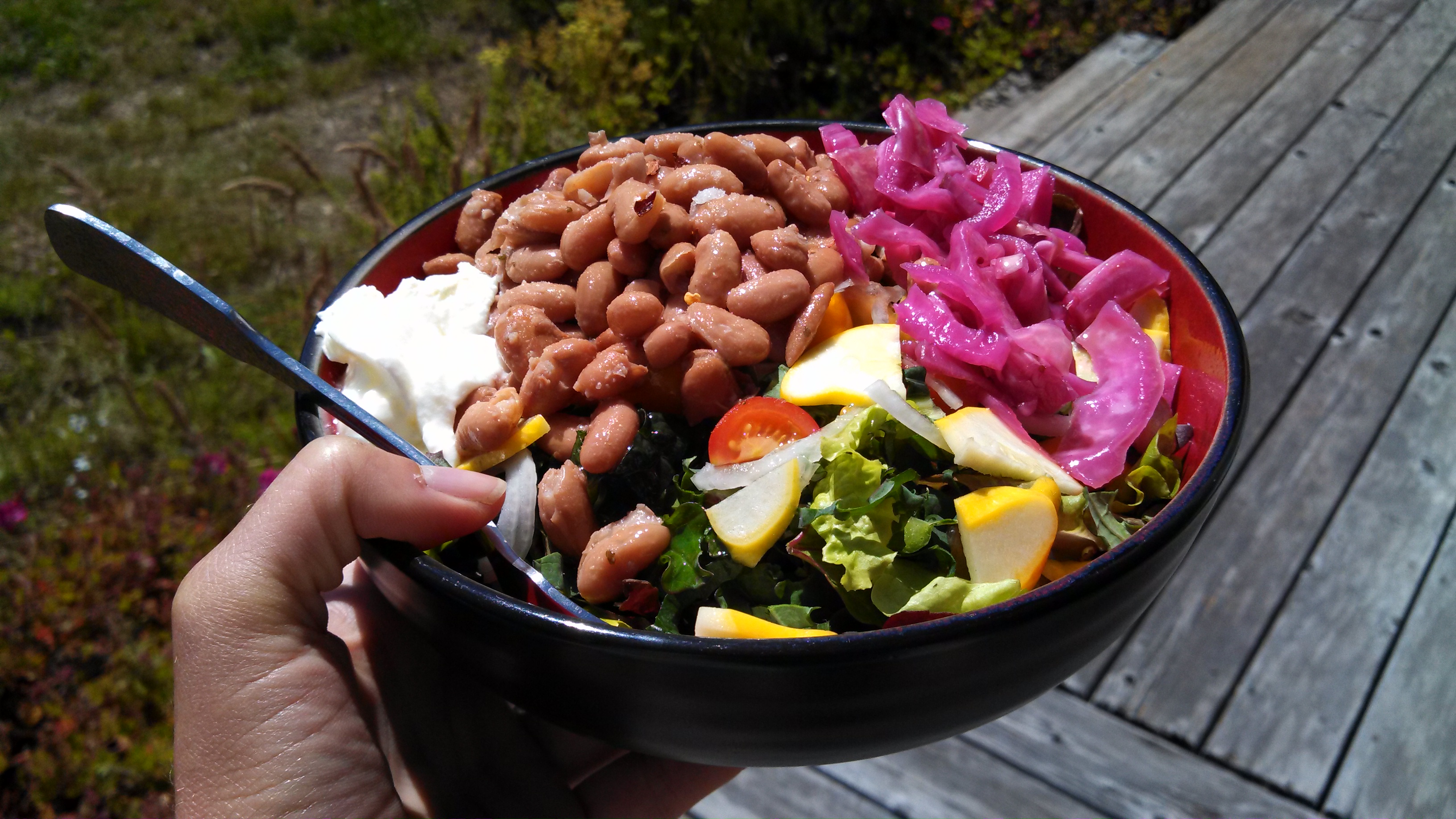
So, how did we celebrate our freedom today? After the parade, we came back to my apartment and I supervised the ever acrobatic Apple while she mowed my lawn and Gowan assembled some patriotic taco salads for us.

Apple the lawnmower

Patriotic Taco Salad

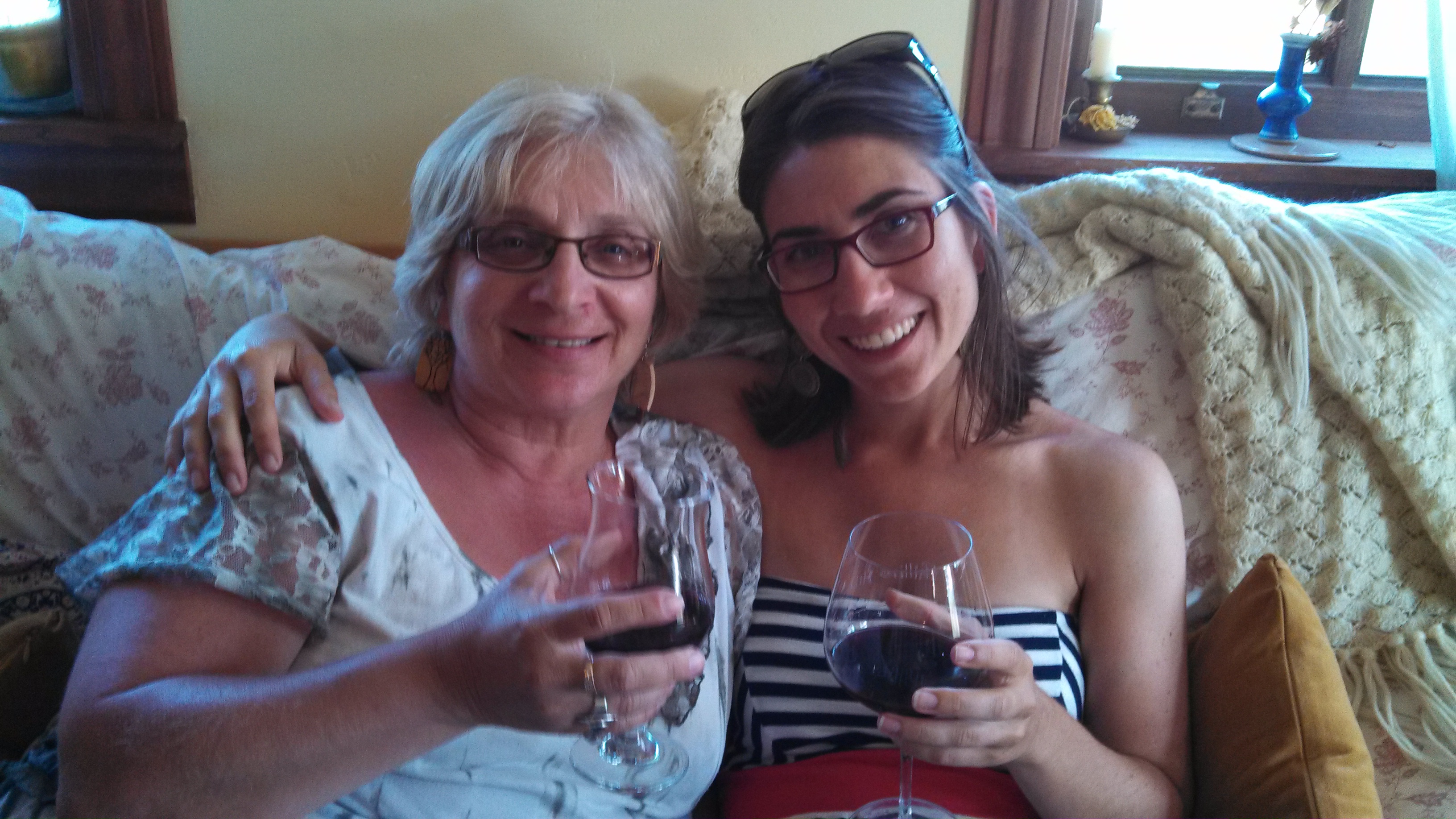
Then mom and I toasted the day with a glass of Mendocino syrah. With every bite, and with every sip, I love this country.

4th of July toast

How to cook beans (not from a can)

People often ask us what has been the hardest thing about eating locally. Most of what we do is not inherently difficult; the biggest challenge is rearranging one’s life around cooking whole foods for every single meal, every day. This requires a complete lifestyle overhaul. We must always think ahead and I rarely leave the house without some kind of food stuffed in my purse. So, the hardest thing is giving up anything premade, whether it be a box of crackers or cereal, a bag of chips, or a can of beans. Honestly, I had never cooked dry beans from scratch before this year. Speckled Bayo Beans

It took us months to track down local beans, and when we did it was tremendously exciting to have a non-animal protein source. These speckled bayo beans came to us via Westside Renaissance Market and they were grown by Guinness McFadden in Potter Valley. When I made the first batch, I ate them every day for nearly every meal for a week and it felt anything but pedestrian; it was like a bean miracle. The simple becomes the miraculous when you have gone without.

Taco salad!

Local Taco SaladHuevos rancheros!

Local Huevos Rancheros

We have said many times that the point of this project is not to get everyone to do what we have done and dive into the deep end of the local food pool. Rather, we hope that people will start looking at their own plates and think about how they might start connecting with their local food supply chain. There are lots of ways to do this – from making strawberry jam to baking bread or simply making time to pick blackberries on a lovely summer day. It all starts with getting closer to the source and cooking from scratch. The more we do this, the more we realize we are capable of.

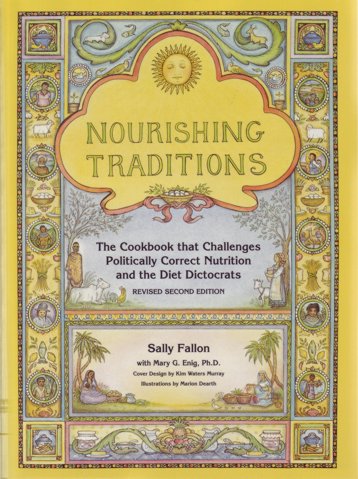
Here is my challenge to you: take one thing that you usually buy in a box, can or bag, and try making it from scratch. Just one simple thing, like beans. And if that’s where you want to start, here’s the recipe, borrowed from Nourishing Traditions (an indispensable book to have on hand in the whole foods kitchen).

Basic Beans

Makes 8-10 cups cooked beansNourishing Traditions

2 cups black beans, kidney beans, pinto beans, black-eyed peas or white beans

warm filtered water

2 tablespoons whey or lemon juice (for black beans only)

4 cloves of garlic, peeled and mashed (optional)

sea salt and pepper

Cover beans with warm water. (For black beans, stir in whey or lemon juice). Leave in a warm place for 12-24 hours, depending on the size of the bean. Drain, rinse, place in a large pot and add water to cover beans. Bring to a boil and skim off foam. Reduce heat and add optional garlic. Simmer, covered, for 4-8 hours. Check occasionally and add more water as necessary. Season to taste.

I have never been good at following recipes. I often throw in some other stuff when I’m cooking the beans. In this batch, I added onion, oregano, and kombu seaweed (for saltiness and trace minerals.)

Pot o' beans

How the jars fill up

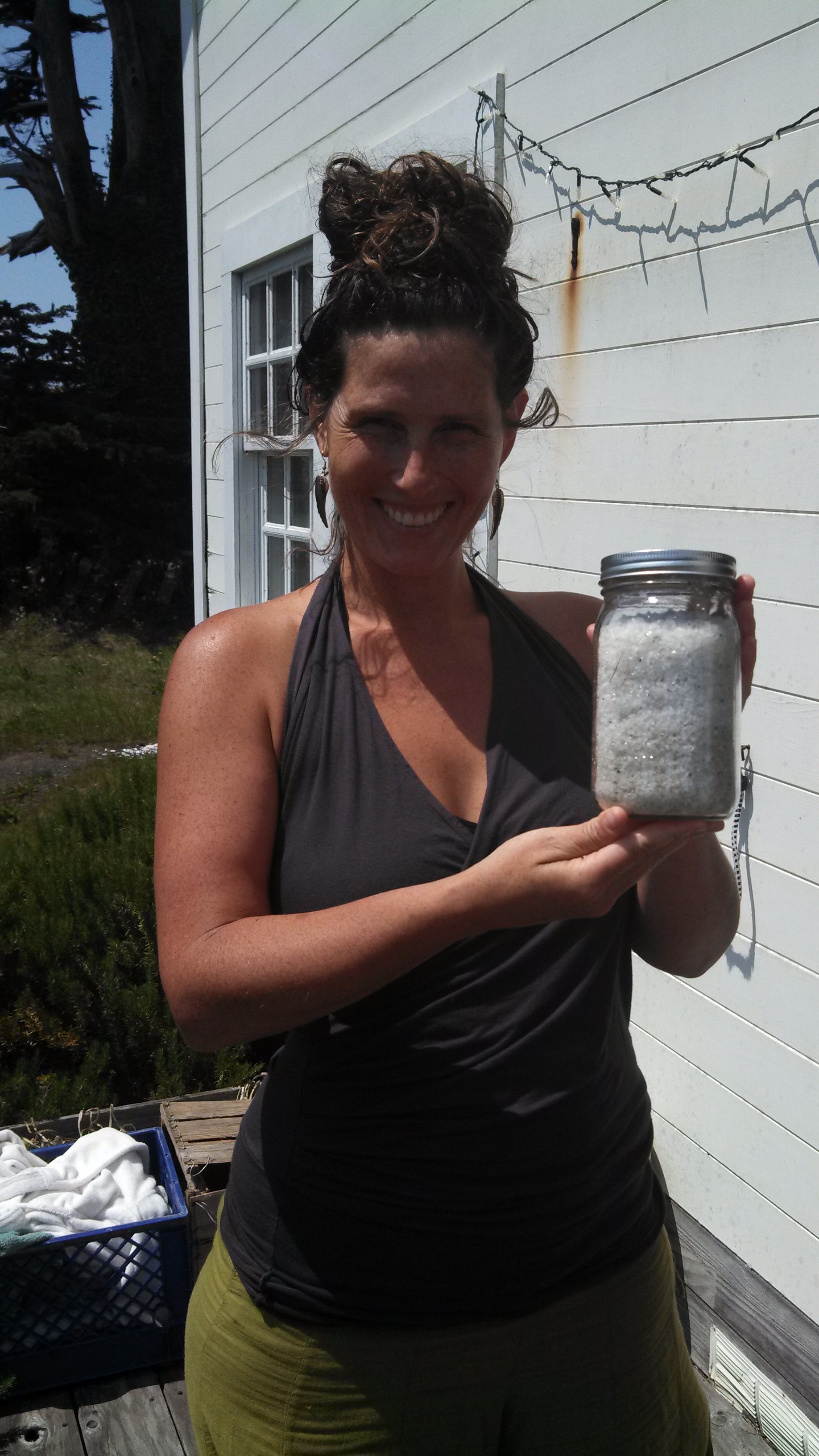
After a week of not seeing Gowan (which feels like an eternity in locavore time) we made a dinner date for tonight. When comparing kitchen stock and discussing who would bring what, Gowan asked the dreaded question, “Do you have salt?” I hesitated to answer, because I knew my stores were running low, but I didn’t know how much she needed. Salt for a meal, or salt to make 4 gallons of fermented veggies? Before I could answer, there was a knock on my door. And this is what I found when I answered:

Salt Angel

A salt angel. Truly. My friend Aleya spontaneously decided to drop by with a gift of sea salt that she had harvested last year. Her timing was beyond serendipitous. I returned to the computer and replied to Gowan, “I have LOTS!!!”

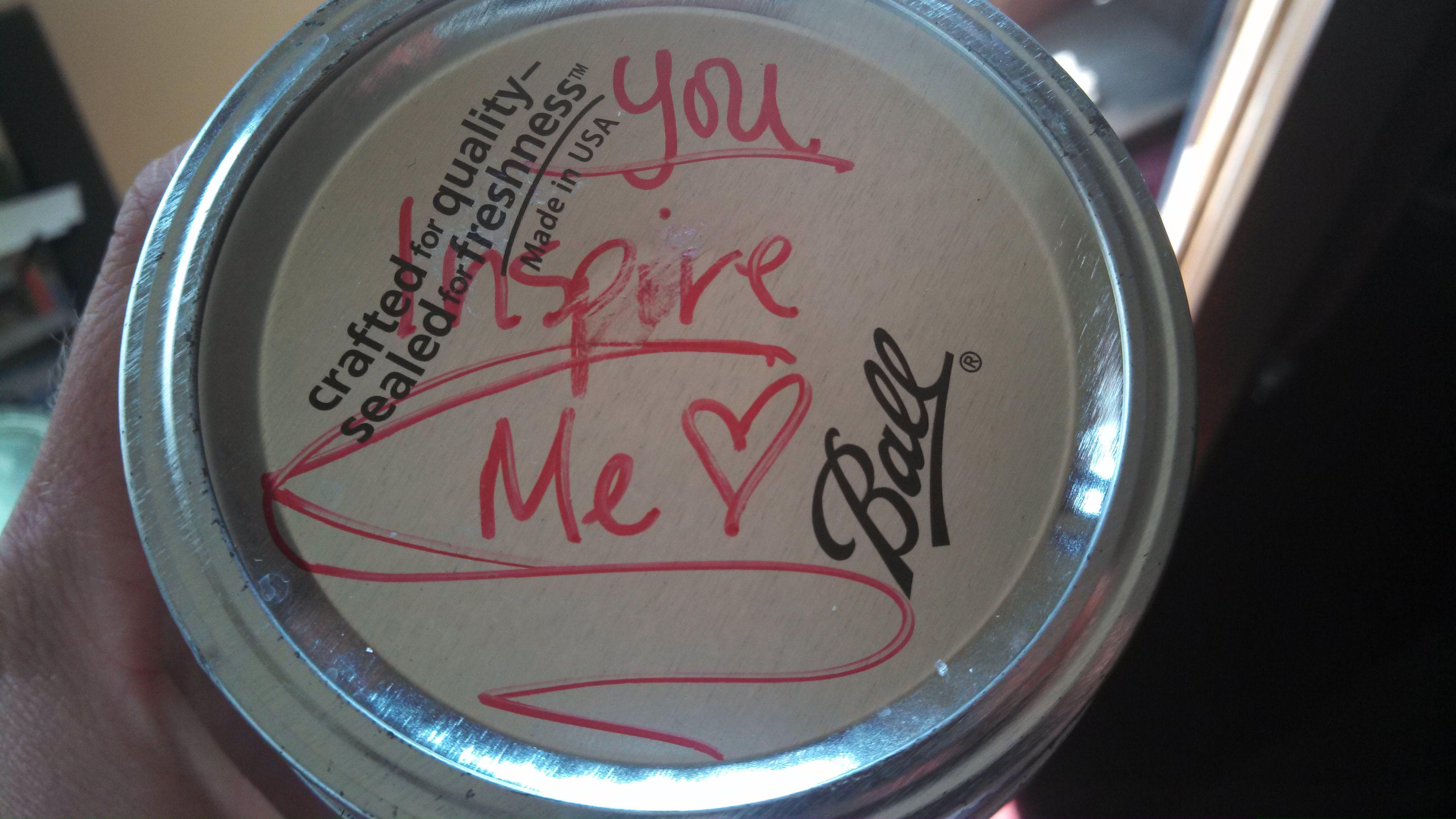
This is how the jars fill up. One by one, when you least expect it. I have described this project as a leap of faith, but it is also defined by the many leaps of generosity and kindness that happen all the time, in the most perfect of ways. The best part about Aleya’s gift wasn’t discovered until after she left.

Message from a salt angel

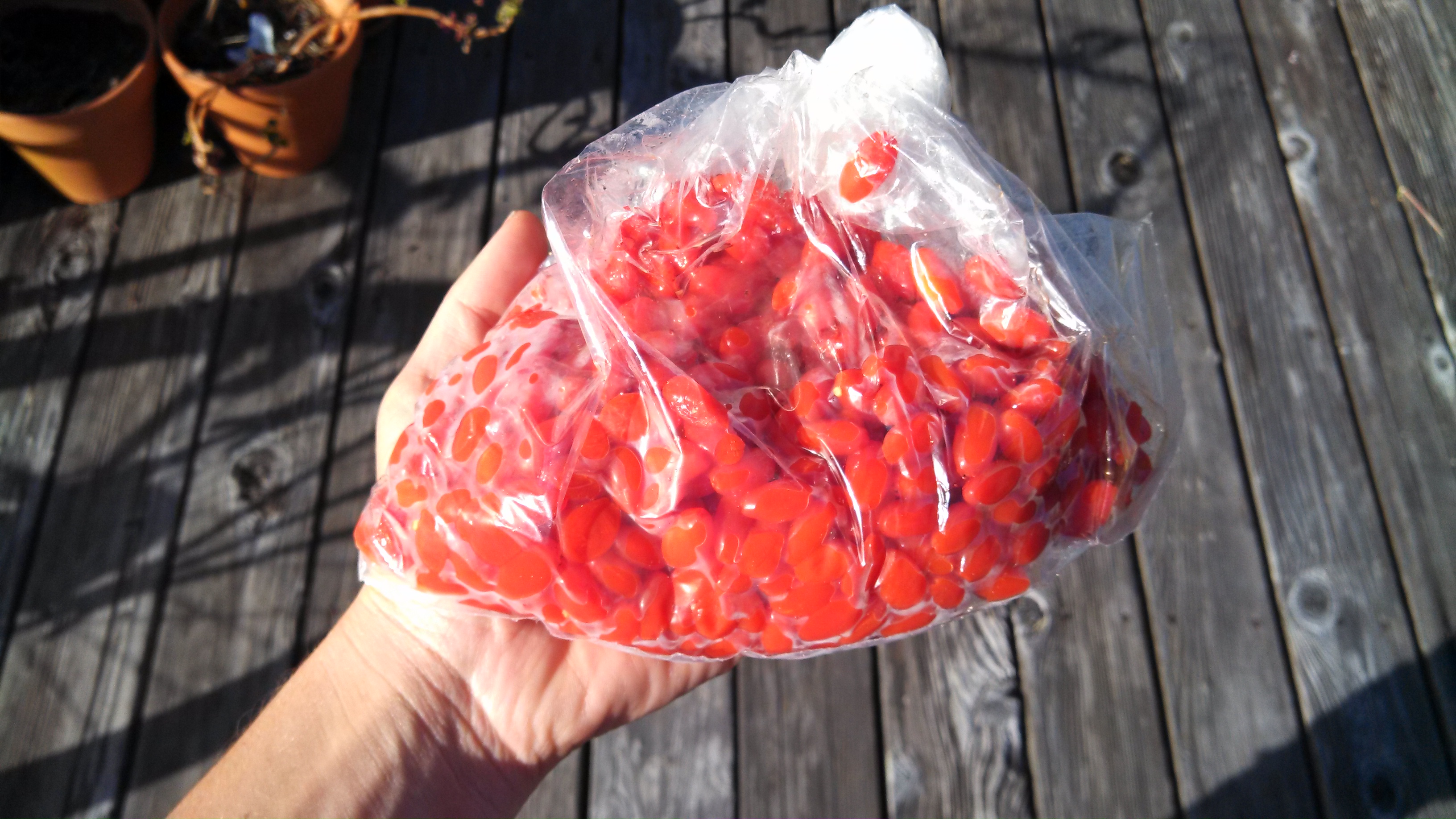
Nothing like a love note on a ball jar lid! These little gifts of sustenance and gratitude have been one of the most profound parts of this eat local experience. We have abandoned convenience and control and opened the door for surprises and miracles. This is not to say that there is not an incredible amount of planning, coordination and intention behind our food life. But, we have also unleashed a new force of unexpected generosity by inviting people into our kitchens through sharing this story. Some of June’s surprises: a fresh-caught fillet of ling cod, a couple pounds of speckled bayo beans and a bag of goji berries grown in Willits!
Goji Berries

I think these gifts are so touching because food is intimate. We need it to survive, so it reveals our vulnerability and our mortality. What we eat and what we grow and forage also reveals something about our lives. Food reflects culture, history, class, tradition and of course, climate.  I stopped by my accountant’s office today and the receptionist exclaimed, “You are famous!” I dismissively laugh at this, but am always delighted when someone wants to talk food. She starts by saying she wouldn’t want to give up cookies, and I assure her that cookies are definitely part of our diet. She also shares that she’s growing peas, and wants to give me some if she has extra. This, too, is how the jars fill up. These food offers always make my heart smile because I know that feeding us is also an endorsement for a new and different food future. One where we talk about food, we share with strangers and we are not so afraid of intimacy.

Next I go to Gowan’s, where her jars are full of delicious fermented veggies from her garden.

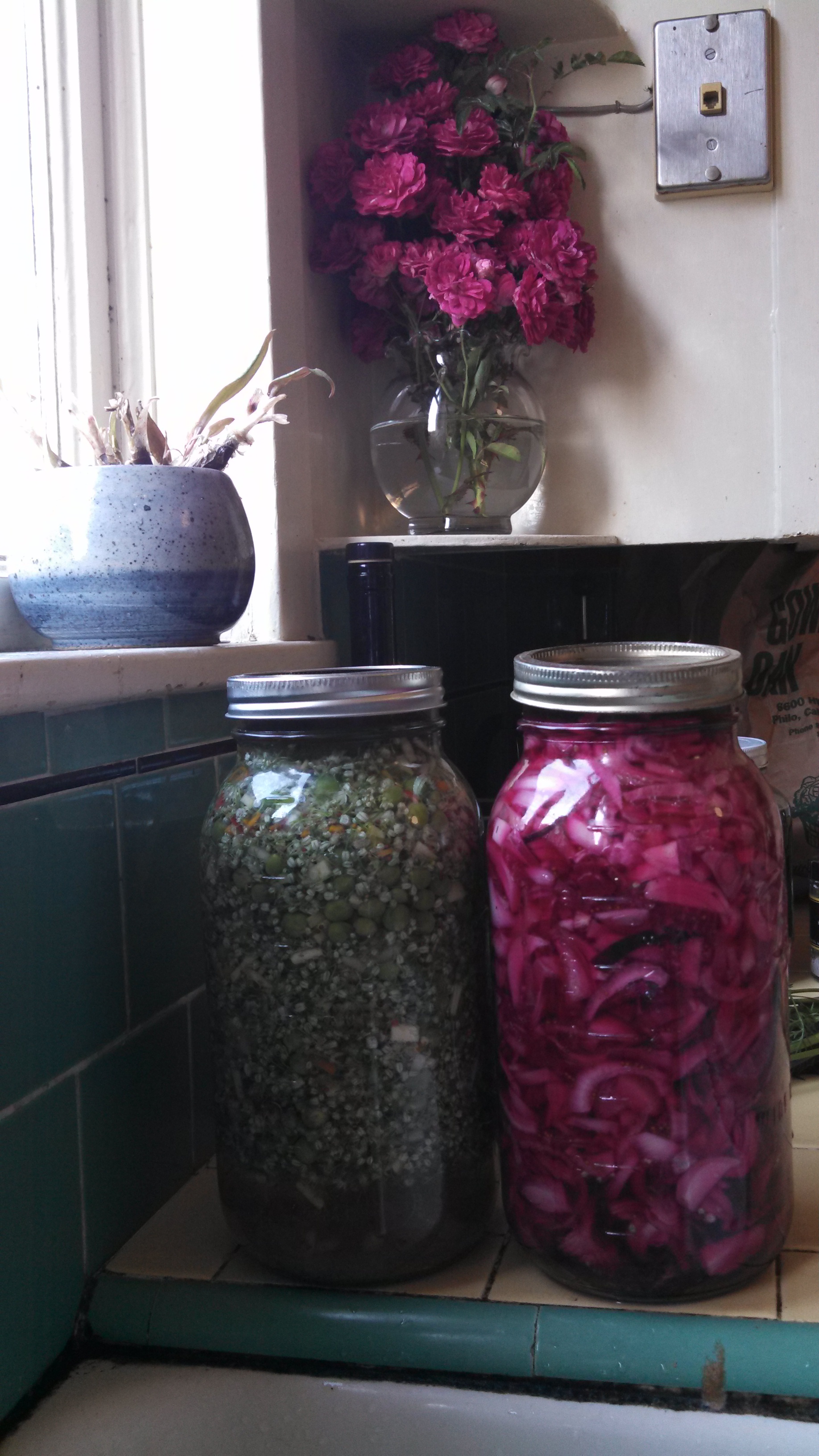
Gowan's fermented veggies

Jar 1 features a green garden medley of onion blossoms, peas, zucchini and red pepper. Jar 2 is sweet red onions and beets. Both are done in a saltwater apple cider vinegar brine.  Thanks to Aleya’s salt, the jars will keep filling up. Gowan also has two dozen duck eggs for me, which were graciously transported over the hill from Ukiah by Supervisor Dan Gjerde. How’s that for public service?! Then we go back to my place to feast on a huge pot of those delicious bayo beans and make a batch of candy-cap custard ice cream with roasted bay nuts. We were too excited to photograph the ice cream. Now, we go to bed with full and happy bellies. Thank you to all of you who have helped fill us up. You inspire us.

Harvest Market forges the path to local food

Welcome to the first installment of the “Eat Mendocino Daily Report,” and the first day of the second half of this yearlong locavore adventure. There is no better way to start a Monday than with a hearty breakfast. I cooked up some breakfast potatoes and two of Gowan’s quail eggs, served with homemade yogurt. Quail eggs are adorable and delicious, but it takes a lot of these to fill a girl up. Eat Mendocino Monday Breakfast

Most homesteaders are experiencing egg abundance at this time of year and eating them with every meal. But, since I’m allergic to chicken eggs, and I have no alternative feathered fowl of my own, I have to import them.  I have run out of duck eggs, and sadly most of Gowan’s quail were killed by a skunk or raccoon recently. One of the complications of the carless life is transporting a few key ingredients from A to B, over long windy roads. I do most of my shopping at the Farmers’ Markets every week, but there are some missing items. The egg beacon is shining, and there will be a balance of power on the morning breakfast plate soon.

This afternoon I went to a monumental and exciting meeting with Harvest Market, our largest locally-owned grocer on the Mendocino Coast. The meeting had been initiated by owner Tom Honer who expressed an interest in getting more local produce on the shelves. This is basically a locavore’s dream come true. Today I sat down with these fantastic folks to talk about the nuts and bolts of making it happen. From left to right, Produce Buyer Jesse, Farm to Fork Coordinator Susan Lightfoot, and Manager Tim Bosma.

Harvest Market Meeting

We discussed the challenges to integrating locally sourced food into the grocery store and how to work strategically with farmers and consumers to carve out a niche for locally produced goods. The idea is to synchronize with the Farmers’ Markets and line it up so that farmers can make deliveries when they come to market. The hope is this expands into a year-round program. Main concerns were:

  • Keeping prices good for farmers, competitive on the shelves and not to compete with the Farmers’ Market
  • The need to feature the stories of the local farms and their products (especially rare and unusual produce items)
  • How to differentiate local produce from the two main existing categories in the market: Organic vs. Conventional – creating a whole new concept for the shopper.
  • Finding and sourcing products from local farms – we can certainly help with that since we have become food ninjas!
  • Signage to highlight local products
  • Creating a clear structure for local producers that walk them through what is required to sell to Harvest, learning from what other stores have done such as Ukiah Natural Foods Cooperative and the Westside Renaissance Market
  • Possible farmer demos to build direct relationships

This is a groundbreaking conversation that will establish a foundation for bringing a significant amount of locally-produced food on to the shelves at the grocery store. As a locavore, one of the greatest challenges is the lack of access to local food, and the outrageous inconvenience of having to buy things at many different locations, during very specific times of day. Plus, many Farmers’ Markets are seasonal and there are months where it is tremendously challenging to track down some local sustenance. Integrating the local food producers into our markets is an essential first step toward a local food economy that can work with our crazy lives.

As Susan said, we can use this opportunity to challenge the consumer to think about “local first.” Instead of going to the store with a list of exactly what you want, this is a chance to see what’s available and start there. This is how we have built every meal since January 1st, and it is no small feat, but it is part of shifting our mindset from what we want to seeing what we already have.

I am wildly excited about this burgeoning effort and highly optimistic that the right people are behind it to actually make it happen. This would be a great time to send love letters to Tom Honer and Tim Bosma and applaud their efforts. Of course, I promised that Gowan and I would be there waving our Eat Mendocino flag when they launch their new local food section, and bring all our fans with us.

Six months of eating local in Mendocino County

I was at a potluck a few weeks ago and a friend told me about the “daily report” that her grandmother emails to the whole family every so that they know she’s alive and well. She is aging and lives alone, so it’s a practical way to keep the family from worrying. It has also turned into an amusing and revealing correspondence that has captured precious family history and deepened their knowledge of her.

I bring this up because I realize many of you may not actually have evidence of our being alive, unless you’re following us on Facebook, or if you saw our smiling faces on the front page of the local paper this week. Otherwise I know I haven’t blogged in over a month, but let me assure you that our hearts beat strongly on the eve of our halfway point for this endeavor. In fact, Gowan had a physical exam at the doctor recently and we can officially report that she is in optimum health. I am recovering quite well from the car accident and we know we owe much to the power of local food. The baby goats are healthy and growing very quickly, too!

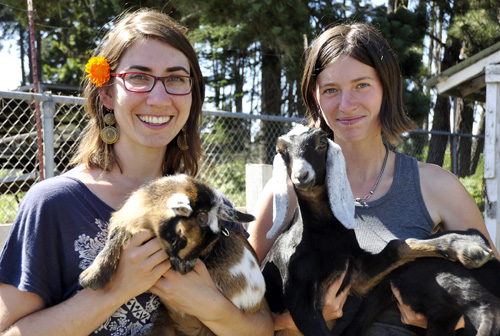
Eat Mendocino girls

As of tonight, we are exactly halfway into this yearlong adventure, and I really can’t believe it has gone so fast. One one hand, it’s impossible to summarize this experience when people ask us, “What has it been like?” But, there are certainly strong themes that have pronounced themselves. Here’s one way to break down what we learned during the first six months of eating local in Mendocino County.

Six-Month Redux: Key lessons
Month 1:  The importance of fat and potatoes.

Month 2:  Pie is a psychological necessity.

Month 3:  It doesn’t work to eat slow food, but drive too fast.

Month 4:  Life is better with ice cream.

Month 5:  It is hard to date a locavore.

Month 6: Summer also has its perils; such eating way too much stone fruit.

Looking toward month seven, I am inspired by my friend’s grandmother to make a new commitment to this project. It’s not enough for you to merely know that we are alive; the real lesson from the daily report is that much is lost by the lack of corresponding regularly. Even in the digital world where we are communicating with our various devices all the time, some of the most important conversations are never part of our daily lives – we wait for the big events or bad news to be in touch.

Our blog is meant to be a window into what it takes to start getting more intimate with your food, and to do that, we must actually show you how we make it all happen, day in and day out. In general the diet has become easier as the months get warmer, but there are new lessons, thoughts, recipes, victories and frustrations each and every day, and they need to be shared. So, I have decided to blog every single day in the month of July. I know myself, and it will be much easier for me stick with my commitment if it’s extreme (thus this entire undertaking!). Plus, eating is so much easier at this time of year, so I can spend less time hunting for food and more time with the keyboard. So, get ready for the “Eat Mendocino Daily Report.” I will only excuse myself from my daily writing regimen if my sister-wife wants to blog. I’ll see you here tomorrow. 🙂

Learning How to Cook – Some Wise Words

Had to share this post by our friends at Mendocino Organics. When people ask us for recipes we are usually speechless; all of our cooking pretty much follows method number four, based on what is seasonally available and on hand. Thanks, Mark Bittman for validating that we have reached a certain level of culinary genius.

Paula Gaska's avatarMendocino Meats

We can’t help it, but we have a thing with Spanish cuisine right now. The climate is similar to our’s, and we both have Spanish blood running through us. Last year, we borrowed and watched all the episodes of Spain…On the Road Again. Who can resist Mario Batali, Gwyneth Paltrow, Mark Bittman, and Claudia Bassols on an eating road trip through Spain, and a theme song sung by Willie Nelson? Fortunately, there is a companion book to the show, including recipes and cultural notes about the places they visit.

Flipping through the recipes of fried eggplant, cordero lechal, and images of jamon, there’s this great transcript of a conversation between Mark Bittman and Gwyneth Paltrow when they were visiting the Alhambra. There’s a bit of the conversation that is actually really poignant in the current conversation about getting back to eating locally and seasonally, and ultimately about…

View original post 211 more words

Will work (really hard) for local food

This is not a glory moment. I don’t even want to write, but this is what it’s all about – the guts, too. I am sweaty, windblown, exhausted and my back aches. Before I explain, I need to say a genuine thank you to all of the wonderful people who supported my micro-fundraising campaign to purchase a bike trailer. I raised the full amount, and the only reason I haven’t bought the new trailer, yet is the very next day, someone generously donated one. Of course I would rather use something old than buy something new, but this bike carriage was designed for carrying children, not cargo, so I wasn’t sure it would work. Today, I found out.

I just got the trailer yesterday and didn’t have time to test it on my bike until this morning, before the market. I wasn’t sure exactly how it attached to the bike, but any way I tried, it just didn’t fit. Might be the size of my bike frame, or the tires. I tried to Google it at the last minute before abandoning the issue for the morning, and packing up what I could carry to the market, and walking. The wind was fierce today, blowing strong and knocking down signs and umbrellas and stirring everyone’s nerves. It was also the best market day so far of the season, probably due to it being Memorial Day Weekend. The tourists (and locals alike) really love the Fort Bragg Bakery’s cookies.

After the market, I was generously offered a ride home with four of the heaviest signs that are used to close the street. I came home to rest from the wind, do the farmers’ market accounting and work for a couple hours before dealing with the rest of the signs. My dog was cagey from being in all day, so i decided to walk her and pull the bike trailer by hand to see what we could haul on foot. I was hoping she would actually pull the thing for me, but she was immediately frightened and skeptical of the new bright yellow & red contraption and was trying to run away from it instead. As we started walking through the village, I noticed people looking at me and my trailer and my adorable pitbull like I was either homeless, or with amusement. At some point I will eventually laugh about this.

After picking up and loading the first wooden sign, foodevangelistsI realized I wouldn’t be able to fit many into the trailer, and also realized that my physical therapist nor my masseuse would approve of this endeavor. I was a clunky scene trying to navigate Mendocino’s non ADA approved sidewalks. I stopped to let some tourists pass and my dog licked their hands as if to say, “please adopt me, she’s gone mad.” I picked up two more signs, and then trudged home. My arms began to ache and my lower back was protesting. I am home now, awaiting Gowan’s arrival. We’re going to make dinner and I will bribe her with dessert to help me pick up the last few signs with her truck. I am wondering why sometimes the simplest things can be the most confounding and the most challenging. I don’t want a car, but I am pretty exasperated by the alternatives as well.

Once again I am left feeling that all of my problems would be solved by having a horse.  And ice cream, with fresh peaches.

The domesticity debate: Feminism & going “back” to the kitchen

Between bowls of chicken soup, I read three things today while resting in bed. The first was a book about the iconic artist Frida Kahlo, the second a Time magazine article about Facebook’s Chief Operating Officer Sheryl Sandberg and her mission to “reboot” feminism, and the third a Mother Jones article titled, “How Michael Pollan Romanticizes Dinner.”  I was trying to rest as my immune system is in overdrive, but all this reading turned me into a bedroom philosopher and got me thinking about my own feministy tendencies. Yes, that is a word; it is my own modification of an -ism that has never quite felt entirely comfortable, but also one I’m unwilling to abandon entirely.

So, I spent the afternoon thinking about what it means to be an ambitious woman in today’s world and also be going “back to the kitchen.” I am not going to make any grandiose statements on the issue, because my head still hurts and I got a little distracted by a visit from Gowan and the famous baby goat, Apple. And, I really wanted to make shortbread cookies tonight. If I write, will someone bake me local cookies? Thanks.

The discussion of domesticity comes down to the fact that a certain number of basic things have to be done to sustain life such as cooking, cleaning, caring for children and pets. This is usually called housework, but it is really survival-work. Because what is more fundamental to life than the preparation of food? These tasks have often been considered “women’s work.” Michael Pollan’s newest book, Cooked, explores the history of women in the kitchen and what drove them out – citing feminism and entering the workforce as causes. I am less interested in what specifically drove women out of the kitchen at this point, and more interested in how i’m going to eat in the next week. This is where it gets interesting and particularly unnerving for me. Now, we don’t even have to wonder who’s going to cook. As Pollan says:

 “For the necessary and challenging questions about who should be in the kitchen, posed so sharply by Betty Friedan in the Feminist Mystique, ultimately got answered by the food industry: No one! Let us do it all!”

I have never been more domestic than I have during the past five months. I have also never been less dependent on a globalized corporate industrial food system that has tried to replace food with ingredients that you cannot pronounce. All of the cooking and dishwashing does not make me feel like I am fulfilling some genetic calling; it makes me feel like I am taking responsibility for my life. Ideally, it has made me aware that it is totally unsustainable to live alone as a single woman if we want to transform the broken systems that support life as we know it. We need neighbors to join together in the growing, harvesting, preserving, and preparation of food. We need sister-wives we can call on when we are lonely, hungry or tired so they can bring us foodstuffs and baby goats to cuddle. We need shared resources such as tools, equipment, and skills. We need a community of people with knowledge that spans many generations and geographies to solve all the problems we face. We need the humility to ask for help and the courage to try to do something we’ve never done before. We need to be willing to swing hammers and bake bread, regardless of whether or not we have a Y chromosome.

In short, reconnecting the dots for a sustainable, fulfilling economy will require the whole damn village – men and women alike. No one should be forced to cook, or do anything they don’t want to. If we all do some of the work some of the time, there is enough for everyone. I am not suggesting that these problems are simple to solve. Neither is overturning patriarchy. Oppression, racism, classism and sexism exist, and they are all reflected in a food system that is built on injustice.

Gowan and I decided to take one giant step toward a better food future in our own lives, to show that it is possible. And, that it is fun, and challenging, too. We are both exhausted from working triple time. The “joy” of cooking is real, and it’s also hard work! As Tom Philpott points out in the Mother Jones article:

So even Julia Child, born in 1912, grew up with servants in the kitchen and scant memories of her mother whipping up dinner—although, to the 1960s-era audience of her television show, live-in cooks were likely much less common than they were during Child’s 1920s childhood, because the cost of labor had risen over the decades. But the point stands: People with sufficient means have long been able to opt out of cooking. What I wrote back in 2009 still sums up my thoughts today:

Pollan was right: people do need to revalue the craft of cooking, to embrace it as a quotidian pleasure, not a mere chore. But if we manage convince them of that, we’ll have achieved something new, not returned to a lost past.

There is no going “back.” No going back to the land. No going back to the kitchen. There is no perfect past where gender relations and domestic duties lie in perfect balance. Our relationship with food has been structured by social movements, political will, economic shifts and cultural norms. Now, it is largely being decided by corporations. So, as we move forward into a new food future, I think the biggest battle is getting Betty Crocker out of the kitchen and getting Monsanto out of the White House. In the meantime, let’s make dinner together. (Seriously, if anyone wants to have us over for a local dinner, let us know! We’d love a break.) And we think men in aprons are sexy.